Australian optometry
Make the right call mid-consult, without breaking your flow.
Review the red flags, check Australian therapeutics, and prepare a prescription PDF or a referral draft, in one structured workflow during the consult rather than after it.
Full access free for 14 days. No card required. Then $29 AUD/month ($290/year) if it earns a place in your consult room.
Live prescribing and referral need an eligible practitioner profile: AHPRA registration, a prescriber number, therapeutic endorsement and the prescribing declaration. What the trial includes
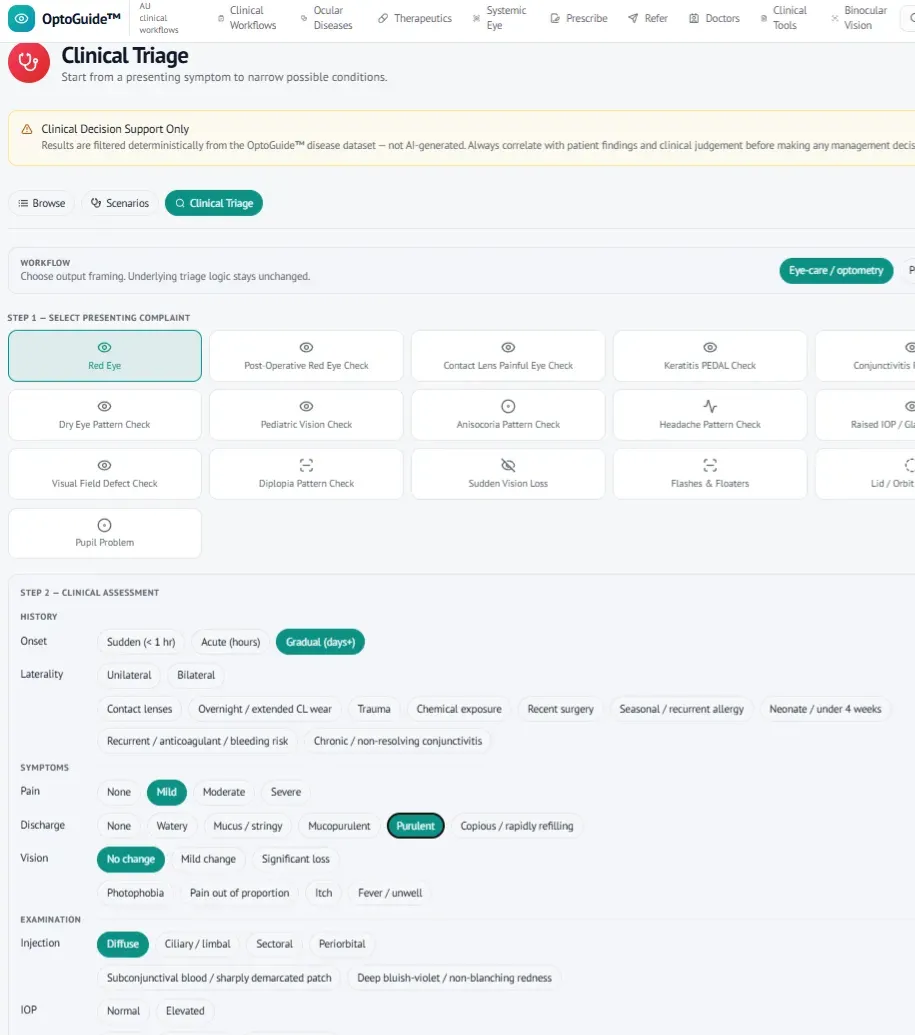
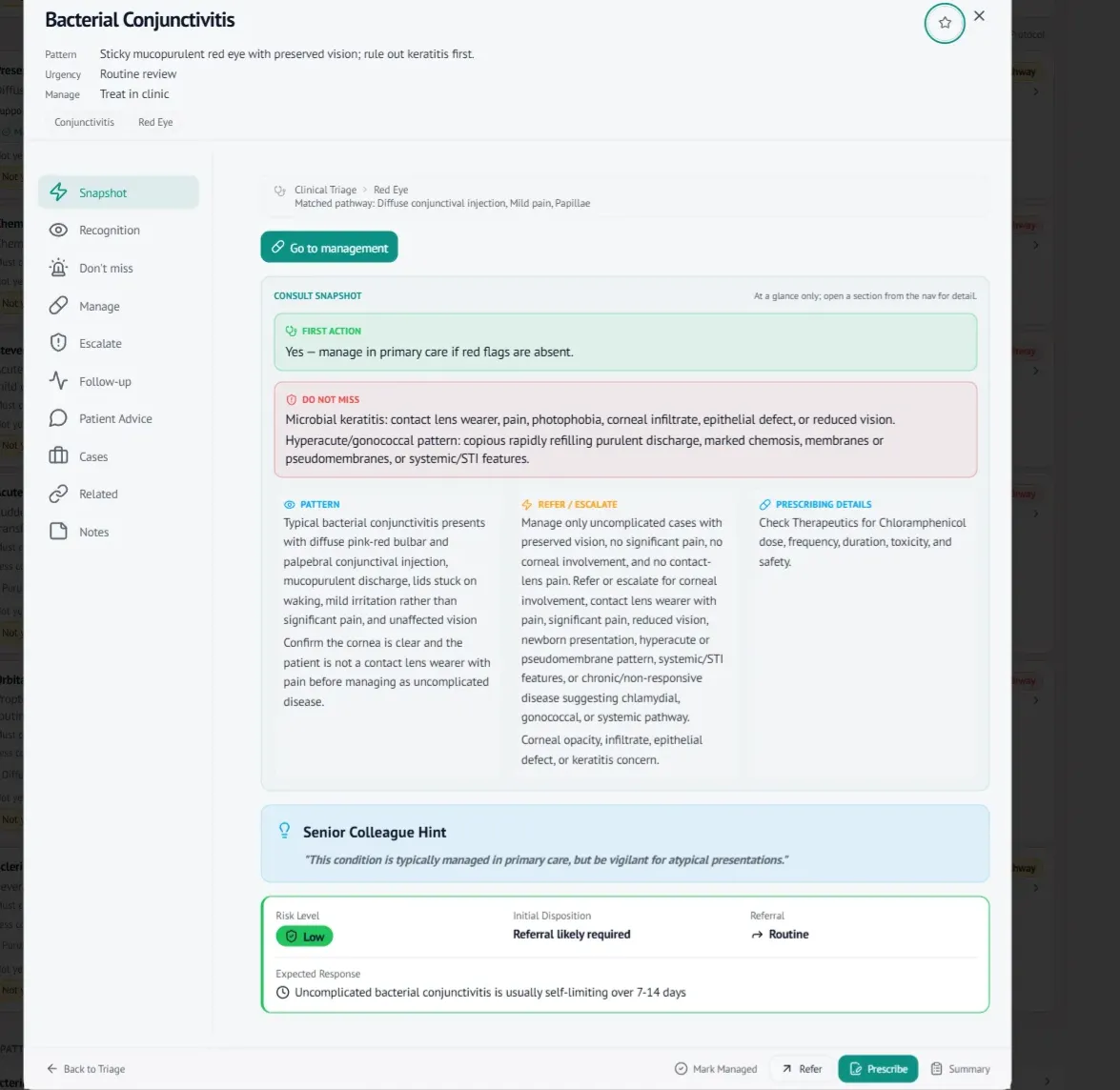
TriageEnter what you see: structured findings, not free-text guessing.
Clinically reviewed by Dr Ankit Mathur, PhD, Grad Cert Ocu Thera, B.S. Optom. How clinical content is reviewed
Trust and safety
Clinical support that stays in its lane.
OptoGuide supports structured decision-making. It does not diagnose, rank probabilities, or replace clinical judgment.
Read the clinical basis and review approach or see how the workflow is used.
Deterministic clinical decision support
Not AI diagnosis
No patient-identifiable data storage
Clinician judgment remains central
How it works
Everything points back to the consult.
Start with the presentation, then move toward disease guidance, therapeutics, prescribing, or referral.
Recognition
Work from what the patient presents with to the conditions that fit, with the don’t-miss list and escalation triggers surfaced before anything narrows.
Browse the conditions coveredManagement and therapeutics
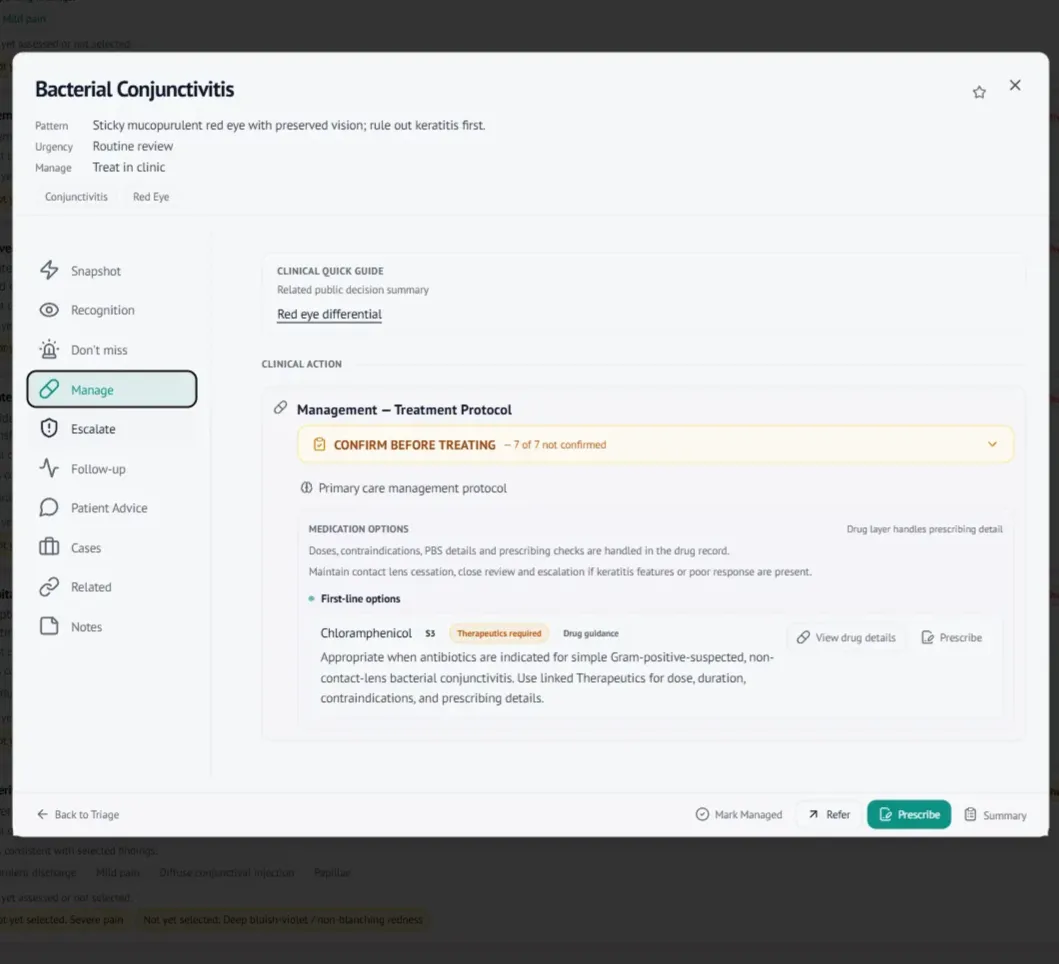
Move from condition guidance to the prescribing layer: Australian products, PBS status and the safety rules that belong with them, held in one place rather than repeated per condition.
Read a clinical guideAction
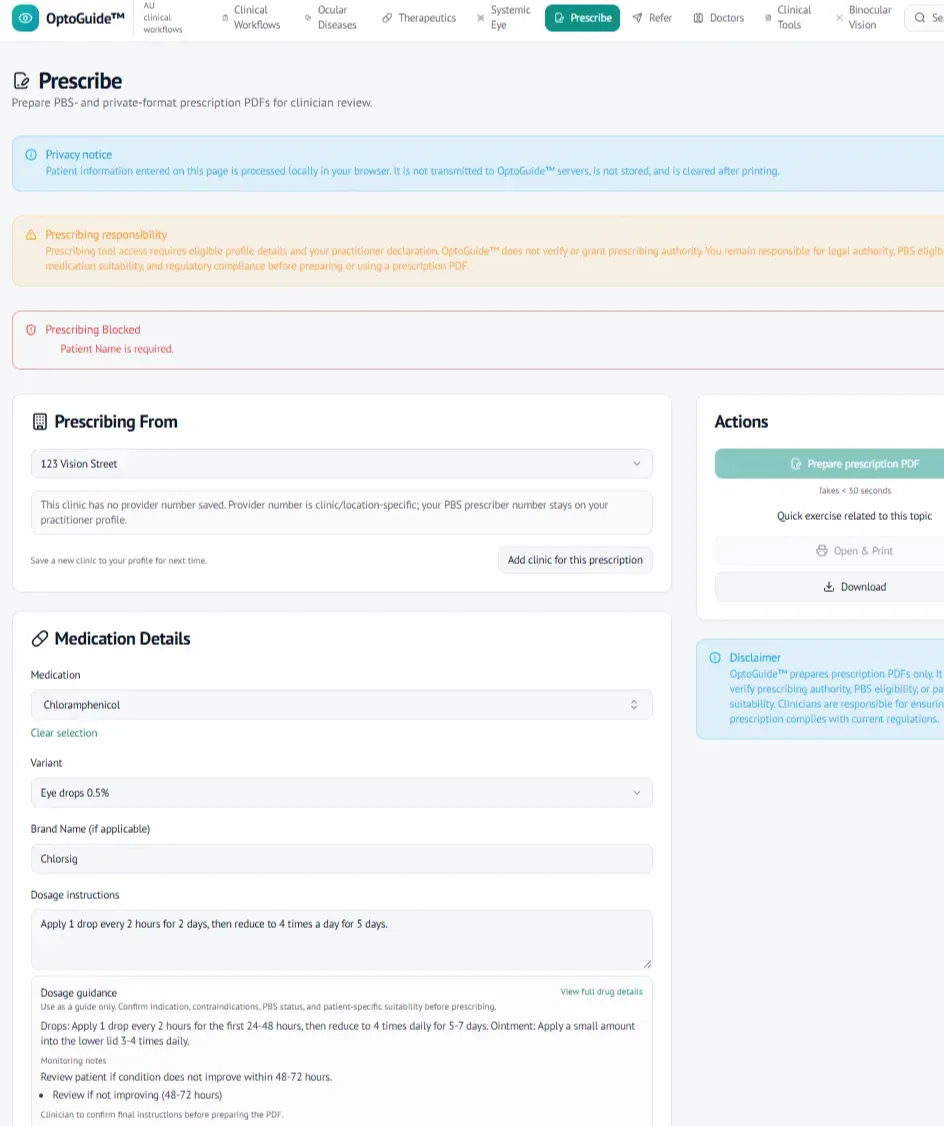
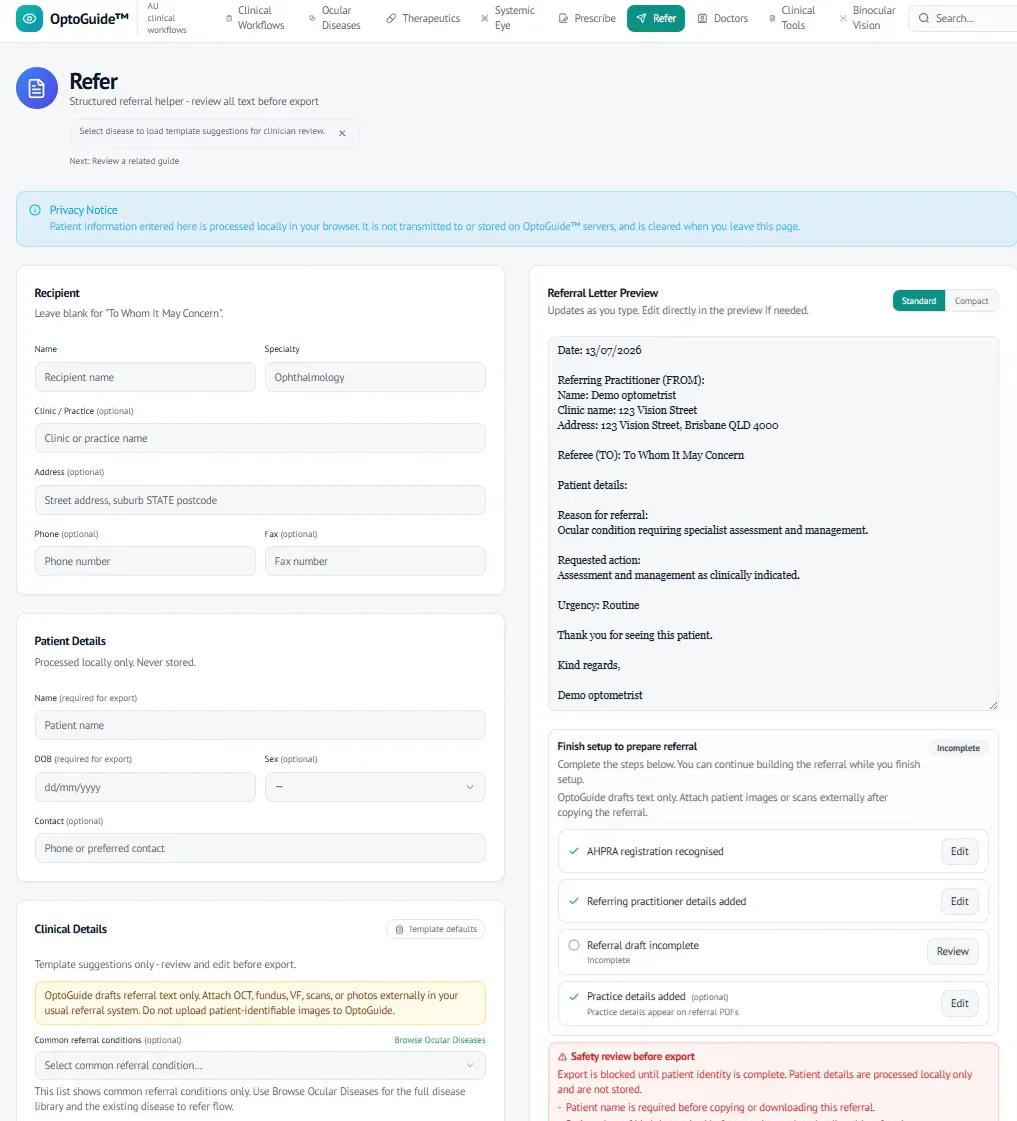
Prepare a prescription PDF on your own device, draft referral text to copy into your practice software, or print patient instructions. Referral is copy-first: OptoGuide never sends anything.
See a worked examplePrefer to try something first? The referral letter generator is open to everyone, with no account and no card.
Plans
One paid plan, with a free preview.
Every account starts with 14 days of full access. Keep it for $29 AUD/month, or stay on Free to browse the clinical reference. Prescribing and referral tools also need an eligible practitioner profile: AHPRA registration, a prescriber number, therapeutic endorsement and the prescribing declaration.
See what is includedFree
$0
Browse conditions and clinical reference, and preview how OptoGuide fits into consults.
Professional
$29/mo
The working clinical tier: prescribing PDF tools, referral drafting, full triage. $290/yr annually, and starts with a 14-day free trial.
Common questions
Before you start the trial.
What can I do during the 14-day trial?
The trial is the full paid product for 14 days, including live prescriptions and referrals once your practitioner profile is complete: AHPRA registration, a prescriber number, therapeutic endorsement and the prescribing declaration.
When the trial ends, subscribe to keep that access. If you do not, live prescribing and referral switch off, and the clinical reference and learning material stay available on Free.
What does OptoGuide cost?
There is a single individual plan at AUD $29/month (or $290/year), with a 14-day trial.
Prescribing access is a separate clinical gate (prescriber number + therapeutic endorsement) and is not something you can buy: it depends on your registration.
Who is allowed to generate prescriptions in OptoGuide?
Live prescribing requires the full clinical gate: current AHPRA registration, a prescriber number, therapeutic endorsement, and the prescriber declaration.
Active in-window 14-day trial users can execute prescriptions once that clinical gate is met, so the trial can demonstrate the paid workflow. Student, free, or lapsed accounts see a worked example only.
Oral/systemic prescribing is blocked for optometrists; the gate is clinical and independent of your subscription price.
Does OptoGuide store patient data?
No patient-identifiable information (PHI) is stored or transmitted. Prescriptions and referrals are generated on your device, and PDF generation is client-side.
Copy-out letters and reports are templates you complete in your own system. They contain no patient identifiers, and nothing you type into them is persisted by OptoGuide.
Where does OptoGuide use AI?
It does not. No AI runs anywhere in the app you use. Every triage score, urgency, threshold, prescribing rule and referral template is deterministic, written and reviewed by clinicians, and nothing you enter is sent to an AI service.
The optional referral assist panel, which suggested wording for referral letters, was removed on 30 September 2026.
Behind the scenes, administrators use an AI model in internal tools that shortlist newly published literature for review, and the learning cases were drafted with AI assistance and then engine-checked before publication (see the learning-cases FAQ). None of this runs while you use OptoGuide, and no model ranks or recommends a practitioner.
Use OptoGuide where decisions actually happen.
Try the full clinical workflow free for 14 days, then decide whether Professional access belongs in your consult room.