Management workflow
Dry eye is the most common thing you’ll see this week.
And most of it is yours to manage. OptoGuide™ structures triage and management so the plan is in front of you — foundations first, with clear cues for when to escalate.
Structured for Australian optometry practice. Source-cited clinical reference; not individually clinician-reviewed.
Clinical decision support only
Red flags: assess urgently before anything else
Most dry eye is optometrist-managed; these features support escalation rather than continued surface management. Focal, dense corneal staining is not the inferior punctate pattern of dry eye — reassess before treating it as surface disease.
- Severe constant pain or photophobia.
- Vision loss that does not clear on blinking.
- Corneal ulceration, thinning, or an infiltrate.
- Reduced corneal sensation with a non-healing epithelial defect — raises concern for neurotrophic keratopathy.
- Severe aqueous-deficient disease, particularly with dry mouth or fatigue — supports screening for Sjögren’s.
One connected workflow, not separate lookups
Recognition, management, prescribing, and referral usually live in different tools. In OptoGuide™ they are one path, and each step hands off to the next so the decision keeps moving.
Step 1
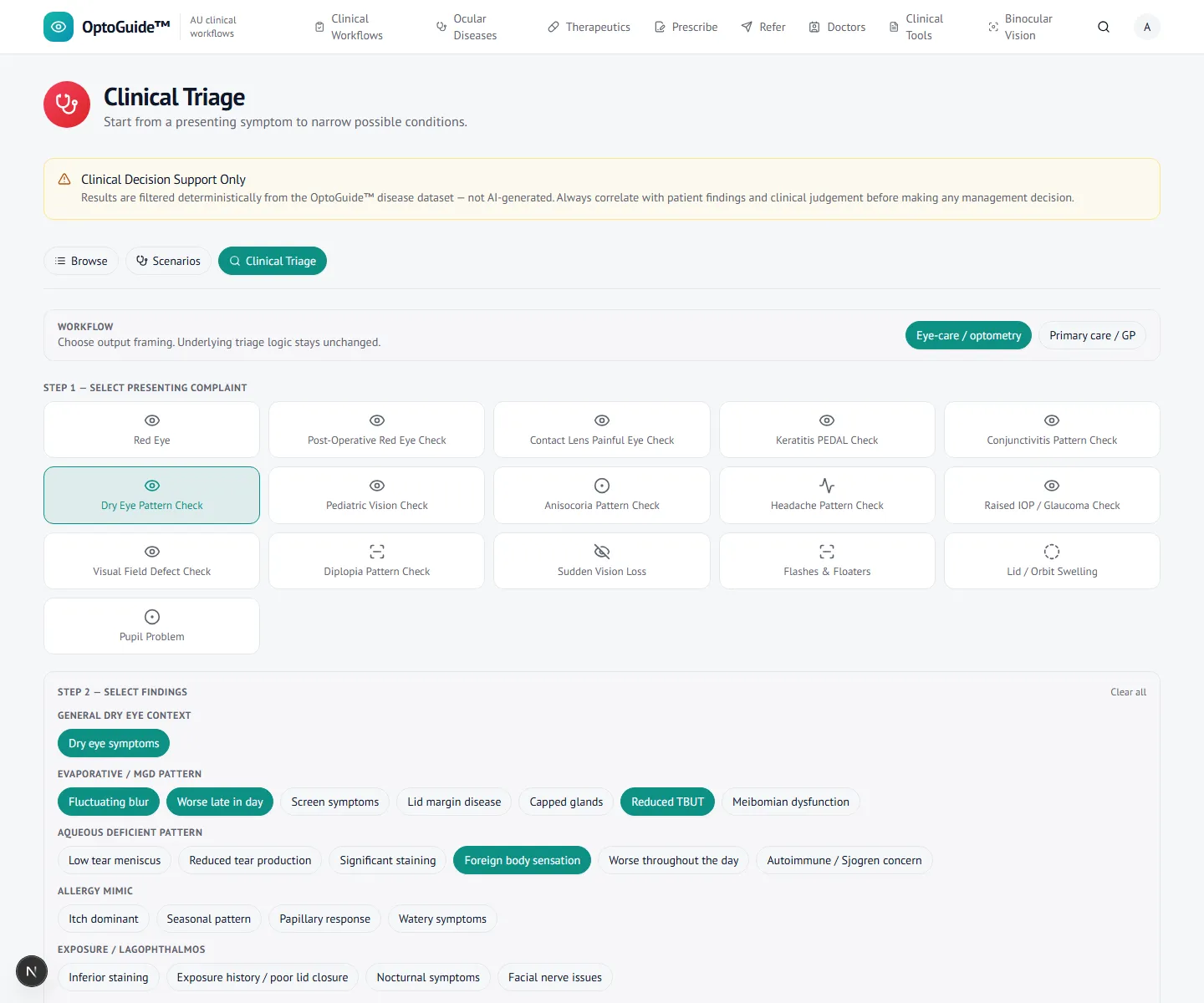
Triage the presentation and findings
Start from the presenting complaint, then the findings — here a dry-eye pattern: symptoms worse late in the day, a reduced tear break-up time, and fluctuating blur that clears on blinking.
- Capture the features that change management, not just the symptom.
- Look for the meibomian-gland component alongside aqueous deficiency — evaporative disease is the most common subtype.
- A watery eye can still be dry eye: paradoxical reflex tearing is easy to misread.
- Ask about medications that reduce tear secretion, and about screen use and contact lens wear.
Step 2
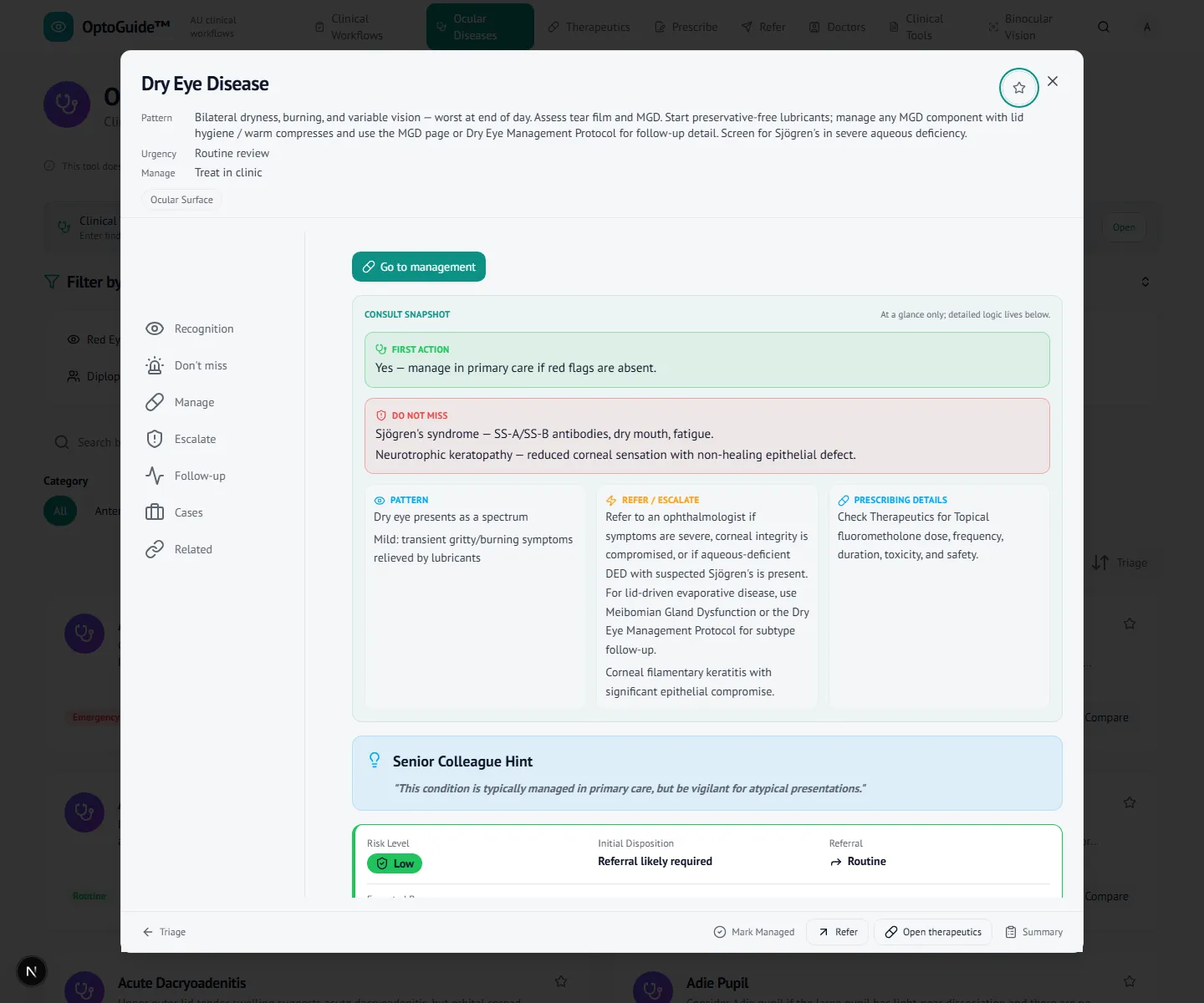
Open the management workflow
The findings surface a deterministic dry eye / MGD pattern. Open the condition for recognition, management, escalation, and review in one view — an optometrist-led first-line plan.
- Set expectations for a chronic condition and build the foundation plan.
- Address the MGD component where present — lubricants alone will not control evaporative disease if gland dysfunction is the driver.
- Prefer preservative-free lubricants where drops are used frequently, and treat co-existing surface disease together.
Step 3
Know when to escalate
The workflow keeps the escalation cues visible so a chronic, manageable condition still has a defined path out when it changes. The clinician reviews and follows up.
- Escalate for severe pain, unremitting photophobia, or vision loss that does not clear on blinking.
- Escalate if corneal integrity is compromised, or if reduced corneal sensation accompanies a non-healing epithelial defect.
- Consider Sjögren’s in severe aqueous-deficient disease and route the systemic work-up accordingly.
Clinical basis
This guidance reflects standard optometric clinical reasoning based on:
- Australian optometry clinical practice patterns
- Australian medicines regulation and PBS prescribing context
- Common ophthalmology referral standards
- Evidence-based clinical training and practice
Put the dry-eye plan in front of you at the point of care.
Free 14-day full-access trial. No credit card required.